





The evolution of a sport is seen in the performances of its champions. In freediving, these performances have been increasing steadily and almost exponentially, over the last 30 years. Unlike previous decades, since 1950, the evolution of records in all open water categories in freediving has not only been impressive, but is based on the emergence of dozens of new champions and hundreds of athletes with very high performances.
In previous years, until 1990 or 2000, freediving records were set by a few talented champions, who left an era with their performances but were few in number: Enzo Mallorca, Jacques Mayol, Umberto Pelizzari, Pippin Ferreiras, Herbert Nitsch and a few more.
After 2000, things changed radically, as thousands of new athletes emerged, determined to achieve their own depth records in free diving. Hundreds of them have proven that they have great potential and dozens of them have already achieved it, in the last 25 years, making the depth record categories in free diving an almost mass sport, on a global level.
The evolution of freediving depth records is certain to provide great excitement in the coming years, because it is now based on this pyramid, which has thousands of talented athletes, from all over the world at its base. The diffusion of freediving knowledge, education, techniques, secrets of freediving physiology and the ease of global communication of experts in the field, champions, coaches, etc. has brought a flood of new possibilities for success, for anyone who wants to try their hand as an athlete, in the field of records, wherever they are on the planet! New, very well-organized, global Organizations of competitive freediving, such as AIDA, are now helping a lot in the rapid emergence of new talents, in championship freediving, mainly by continuously organizing new depth record events, in all the seas of the planet.
For a young record-breaking athlete, the most important thing is the organized support he will find within these teams, who train all year round, to increase their performance and achieve some distinction. Even the richest sponsorship (which, after all, does not exist and never existed in a relatively small sport group, from an economic point of view, like the sport of freediving) could not ensure a young talented athlete the training, that a freediving depth record requires.
The cost of a training platform, coaches, safety divers, medical safety personnel and all the infrastructure required to train every now and then, at the extreme depths of the records, below 100 meters, would be enormous for a single athlete and his sponsor, or even a group of companies, to undertake. Thus, the problem is solved by group gatherings of athletes, by organizations, such as AIDA, which are repeated at least every year. In recent years, for example, we have had a major competition event for new depth records almost every six months, from the two major organizations of competitive free diving, CMAS and AIDA, each of which organizes its own annual global competition meeting of deep-sea athletes, every year.
Depth records in free diving have been distinguished into 5 categories:
1. Constant Weights with a Monofin (CWT).
2. Constant Weights with Bifins (CWTB).
3. Constant Weights with No Fins (CNF).
4. Free immersion (FIM).
5. No Limits (which has been abandoned by the CMAS and the AIDA organizations).
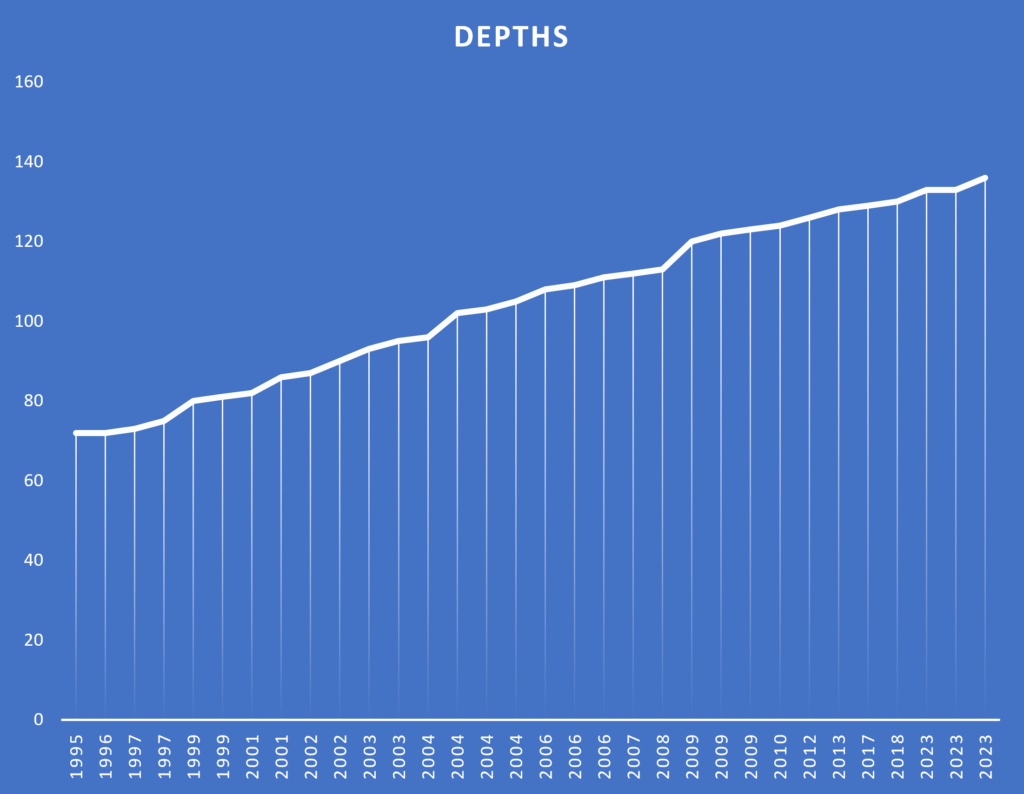
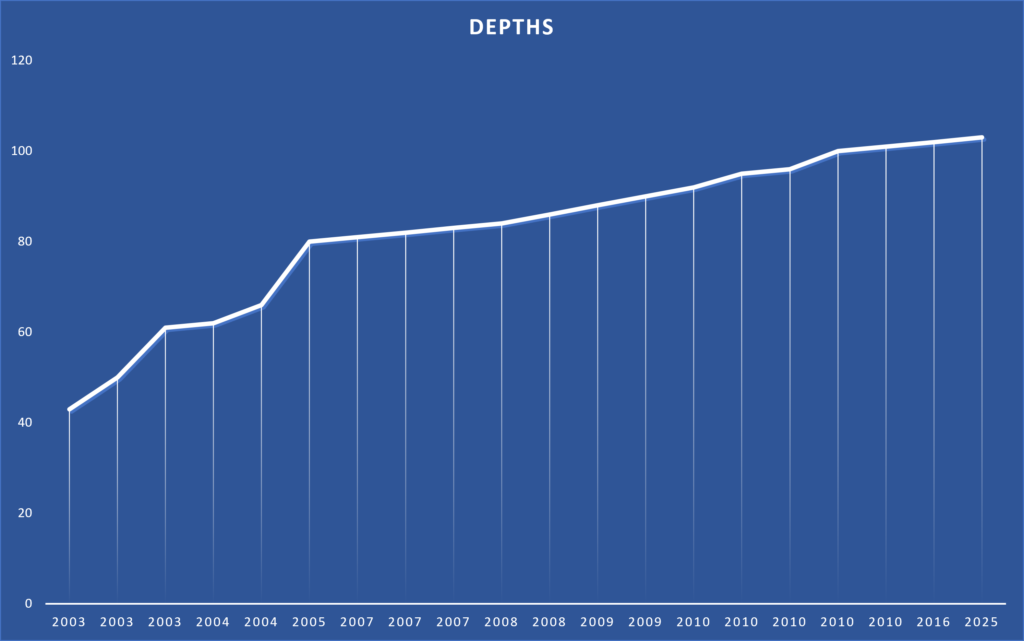
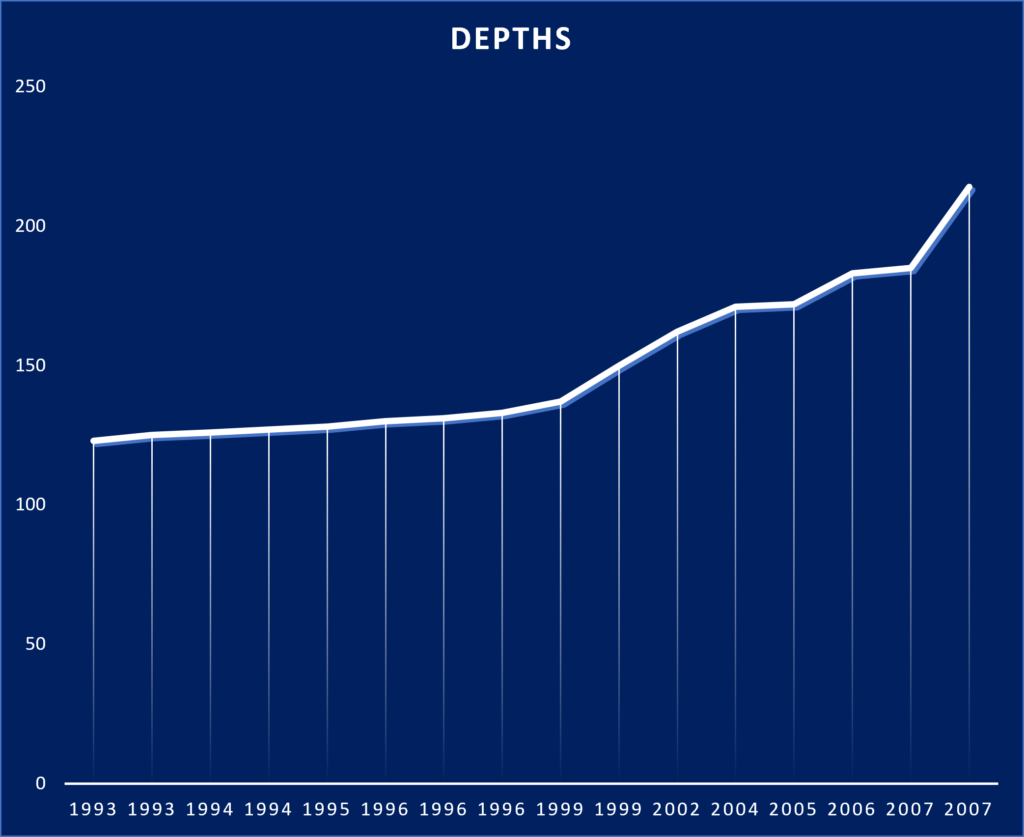
The evolution of depth records in all categories is impressive and shows an almost exponential curve of performance increase, over the last 20 years. In No Limits, it reached 214 meters in 2007, in monofin 136 meters in 2023, in double fins 128 meters in 2026, in the no fins category 103 meters in 2025, and in free immersion 137 meters in 2026!
The increase in the depth of records, below 100 meters, has already created huge problems in the organization of the competitions, because great technical difficulties and greatly increased costs arise, if an organizing group wants to offer quality and safe organization of these meetings. And this is expected to become tremendously more difficult, as the records are already approaching 150 meters in depth, in most categories!
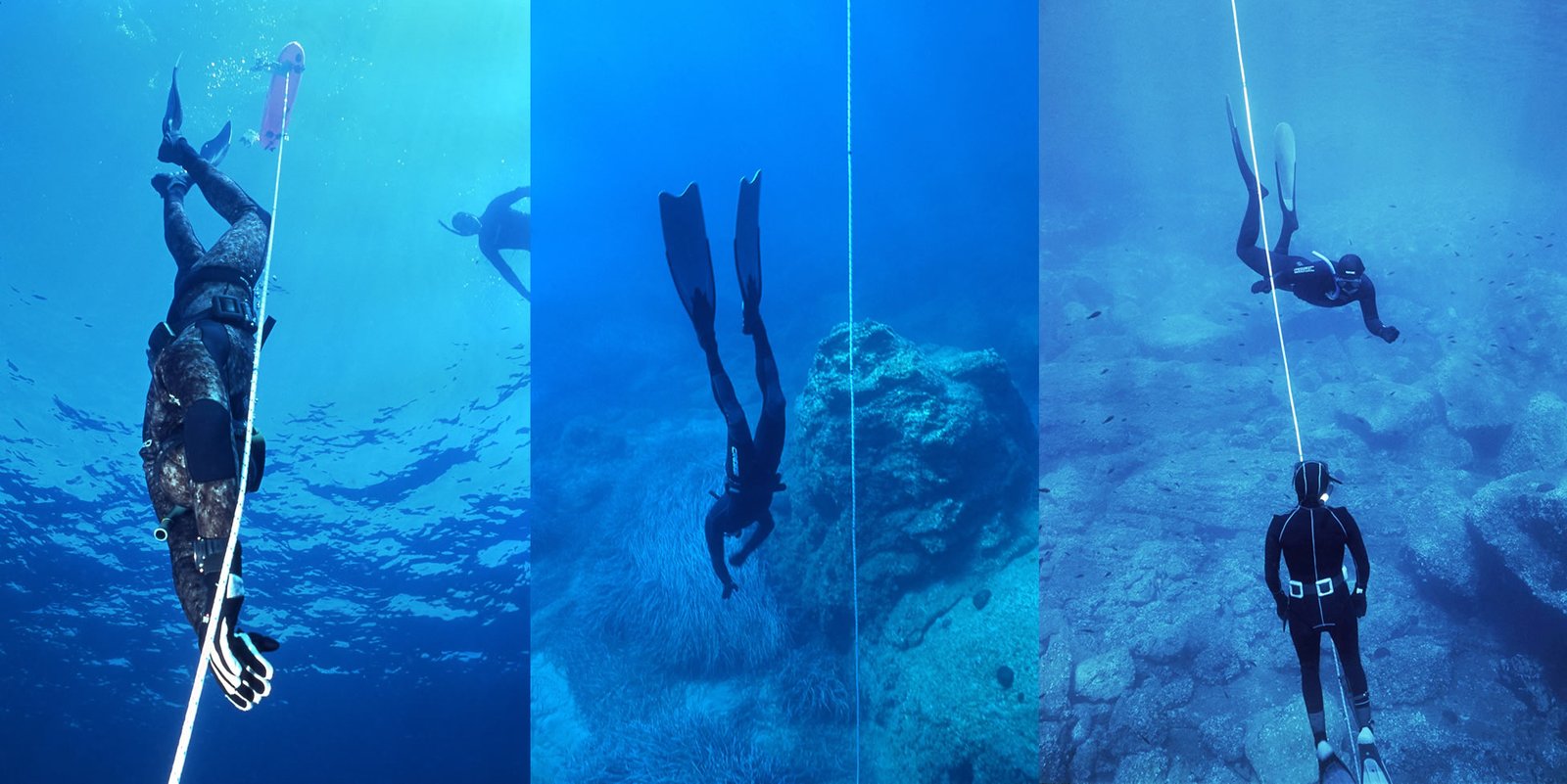
The technical difficulties start from how to support a floating platform in the open sea and keep a rope stretched vertically up to 150 meters deep and end up with the need for a lot of safety athletes, who go up and down on scooters down to 40 meters, to watch over each diver who emerges and accompanying him, because if there are few people, they will be charged with so much nitrogen, that decompression sickness will occur in all safety divers. Also, the existence of means of rescue and treatment of a barotrauma or a decompression sickness of an athlete, means the existence of a hyperbaric oxygen chamber in an ICU (Intensive Care Unit), in a large hospital, near the event site, ready to immediately welcome an injured athlete, transported there by speedboats, ambulances or helicopters. Similar provisions, of course, skyrocket the cost of the event, but it could not offer even basic safety otherwise, when we are talking about freediving to 130 – 150 meters deep!
Perhaps the cost problem will be solved in the future with the entry of large companies as sponsors or in the concept of sponsor – advertiser. As freediving becomes more popular as a sport and spreads as a favorite hobby of thousands of people around the world, we can be optimistic that large companies will appear as sponsors, who will be interested in advertising in the field. So far, however, the financial strength of the freediving field is small, to undertake such high-cost events in the near future and the competitions are in danger of being reduced in frequency (e.g. held every 4-5 years and not annually) or even worse, of having poor quality events, with many accidents and low-quality rescue and care for any athlete who is injured. Both of these possibilities would cause a reduction in the speed of development in the future for freediving and a stagnation of depth records.
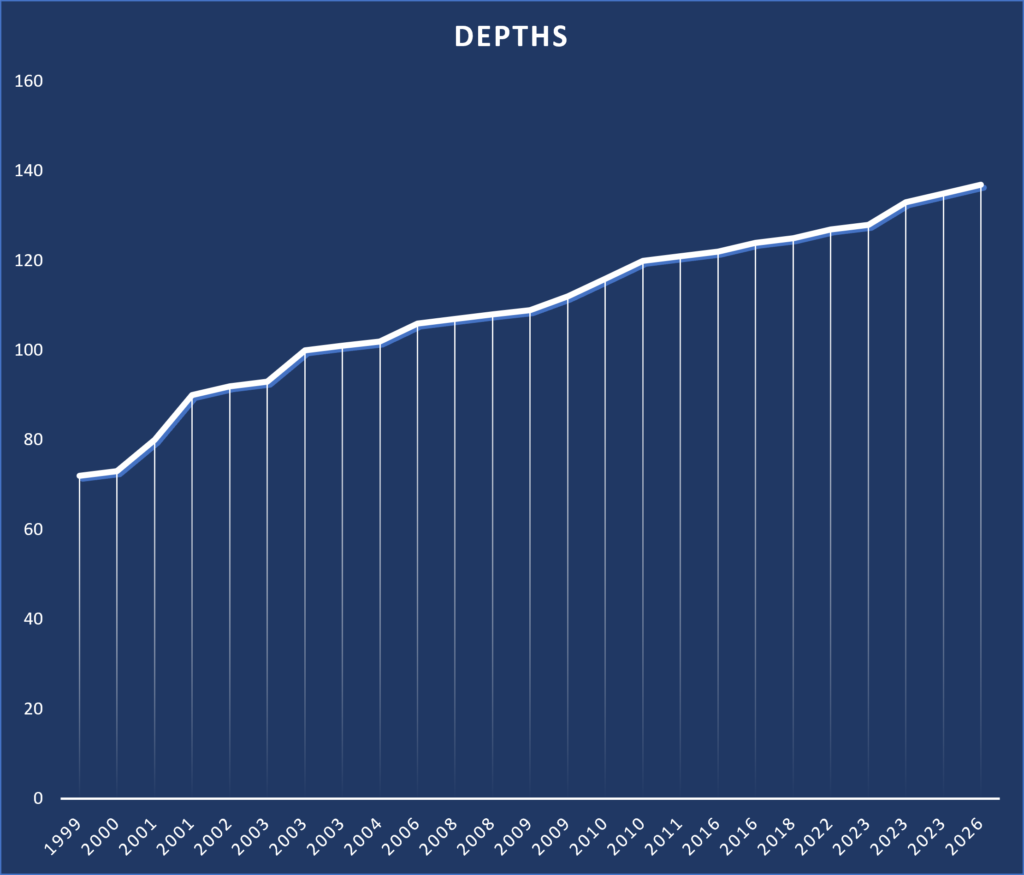
But there is also a more natural risk to the evolution of depth records. In all depth record categories, we have seen in recent years a steady and painful small increase every one or two years in performance, with slightly greater performances. This proves that the sport has matured and its champions no longer make “depth-performance leaps”, but rely on their painstaking annual training that usually brings these small performance steps, to some already very large and difficult depth records. Even this small annual increase in performance, however, if we look at it from a decade perspective, leads to huge new record depths every 5-10 years, to the point where one wonders whether this can continue in the future or whether we will eventually fall as a sport into some “wall”, into an insurmountable barrier, of unachievable deeper dives.
This has already happened in the No Limits category, where Herbert Nitsch’s talent brought him far ahead of any other champion, making a leap in performance at 214 and 253 meters deep (where he risked losing his life from narcosis (probably from CO2) which eventually caused him to faint and caused an uncontrolled ascent resulting in severe freediving decompression sickness). The result was that the Organizations abandoned the No Limits category considering that it would be too dangerous for anyone to attempt to descend deeper than 214 meters in the future and that it would be too difficult and expensive for an organizer to carry out such a record-breaking operation.
So, one wonders if this will be the future of any new depth record events: that is, slowly the Organizations will abandon depth records, especially after 150 meters, and practically declare their inability to support new events. This will bring us back to the era of Mayorca, Mayol, and even Pelizzari and Pippin in the 1990s, who had to organize their own attempt for a new record, finding sponsors and financiers wherever they could! Of course, this will freeze any new development in performance, since even for an already famous champion, already a holder of some records, securing such rich funding is practically impossible.
The champions of the depth records have proven over the last 25 years that, for them, there is practically no limit, to achieving new records. With their talent, hard training and their love for freediving, they show that they are unstoppable and determined to continuously improve their performance, by conquering new depths in all categories of record freediving. At the same time, new great talents are emerging from the thousands of young passionate athletes worldwide, so we justifiably expect to see many new depth records in the coming decades, now getting closer and closer to the once unimaginable number of 200 meters depth in all categories!!!
The physiology of free diving does not, of course, set a limit to all of this, but it warns that man has to face new challenges, in these enormous depths, that we have approached so quickly in recent years. In this zone, narcosis from gases dominates (all gases acquire an extremely narcotic effect on the brain). The main dangers here will be nitrogen intoxication and fainting at the bottom or on the ascent from CO2 narcosis (a new theory that I analyze in my special book “Narcosis at the Extreme Depths of Freediving”). Without overlooking the risk of decompression sickness, which also becomes a certain possibility at these depths and requires special measures during the ascent (slow ascent speed in the last 60-70 meters and breathing 100% oxygen for a few minutes, at 5 meters at the end of the ascent).
As has been the case to date, the obstacles and dangers of greater depths have never led to a cessation of human ambition for greater depths. On the contrary, the freediving champions have learned from their experience and from the new discoveries of freediving physiology, how to proactively face these dangers and how to ultimately avoid them, with the correct planning of the dive to a record depth.
Training has shown that there can be adaptation to nitrogen narcosis, if a depth is repeated many times, so that eventually the diver can function safely, accustomed to the narcotic effect of nitrogen at that depth. Something similar will happen with CO2 narcosis: we will learn to avoid it by reducing the ascent speed or by some other method that has not yet been discovered.
We already know a lot about the freediving decompression sickness and how to avoid it, mainly by the slow ascent in the final 60 meters and by the preventive decompression with pure oxygen, at 5 meters. The freediver will never cease, like any mariner, to be resourceful, discovering and using innovations in the water, which the sea and the deep generously offer, something like the resourceful Odysseas!

Continue the Conversation
Share your thoughts, ask a question or contribute your experience below.